Unit 03 — Business Cycle and Macroeconomic Policies
What business cycles are and what phases they pass through, what causes fluctuations, and how fiscal and monetary policy are used to stabilise the economy.
Your midterm portion covers Unit 3 up to Economic Stabilization — Monetary Policy and Fiscal Policy. The full course syllabus continues Unit 3 into Inflation — meaning, types, causes and effects; policy measures to control inflation; inflation in less developed countries; and the Phillips Curve Syllabus p. 1, but those topics fall after the midterm cut-off you gave, so they are not covered here. Units 4 (Central Bank and Money) and 5 (Government and Private Business) are likewise outside this portion.
1. Introduction to Business Cycles Core syllabus concept
1Understand the Concept
Free-enterprise capitalist countries have registered rapid economic growth over the last two centuries, but that growth has not followed a steady and smooth upward trend. There has been a long-run upward trend in GNP, but periodically there have been large short-run fluctuations in economic activity — changes in output, income, employment and prices around this long-term trend p. 585.
The period of high income, output and employment is called expansion, upswing or prosperity; the period of low income, output and employment is called contraction, recession, downswing or depression. These alternating periods of expansion and contraction in economic activity are called business cycles — also known as trade cycles.
Keynes defined it thus: "A trade cycle is composed of periods of good trade characterised by rising prices and low unemployment percentages with periods of bad trade characterised by falling prices and high unemployment percentages."
Are they really "cycles"? Calling these fluctuations cycles means they are periodic and occur regularly — though the textbook is careful: perfect regularity has not been observed. The duration has varied from a minimum of two years to a maximum of ten to twelve years. Some cycles have been very short, lasting two to three years; others have lasted several years. In some there have been large swings away from trend; in others the swings have been moderate.
2Why business cycles matter — their costs
Business cycles have been very costly in the economic sense p. 585:
- During recession or depression many workers lose their jobs, causing large-scale unemployment and a loss of output that could have been produced with full employment of resources.
- Many businessmen go bankrupt and suffer huge losses.
- Depression causes human suffering and lowers levels of living.
- Fluctuations create uncertainty, causing anxiety about future income and employment, and involving great risk for long-run investment.
- Even a boom, when accompanied by inflation, has social costs: inflation erodes real incomes, makes life miserable for the poor, distorts resource allocation, redistributes income in favour of richer sections, and impedes economic growth.
Crowther summarises it: "On the one hand, there is the misery and shame of unemployment with all the individual poverty and social disturbances that it may create. On the other hand, there is the loss of wealth represented by so much wasted and idle labour and capital."
3Exam-Ready Answer
Although free-enterprise capitalist countries have registered rapid economic growth over the last two centuries, that growth has not followed a steady and smooth upward trend: there has been a long-run upward trend in Gross National Product, but periodically there have been large short-run fluctuations in economic activity, that is, changes in output, income, employment and prices around this long-term trend. The period of high income, output and employment is called expansion, upswing or prosperity, and the period of low income, output and employment is called contraction, recession, downswing or depression. These alternating periods of expansion and contraction in economic activity are called business cycles, also known as trade cycles. As Keynes described it, a trade cycle is composed of periods of good trade characterised by rising prices and low unemployment percentages, with periods of bad trade characterised by falling prices and high unemployment percentages. Calling these fluctuations cycles implies that they are periodic and recur in a more or less regular fashion, although perfect regularity has not been observed: the duration of a business cycle has varied from a minimum of two years to a maximum of ten to twelve years, some cycles being very short while others last several years, and the swings away from trend being large in some cycles and moderate in others. Business cycles are very costly. During recession or depression many workers lose their jobs, producing large-scale unemployment and a loss of the output that could have been produced with full employment of resources, while many businessmen go bankrupt and suffer heavy losses. Fluctuations also create uncertainty which causes anxiety about future income and employment and involves great risk for long-run investment. Even a boom, when accompanied by inflation, has social costs, since inflation erodes the real incomes of the people, distorts the allocation of resources, redistributes income in favour of the richer sections and impedes economic growth.
4Possible Exam Questions
- What is a business cycle? Define it and explain its meaning.
- "Business cycles are recurrent but not perfectly regular." Discuss.
- Explain the economic and social costs of business cycles.
2. Phases of Business Cycles Core syllabus concept
1Understand the Concept
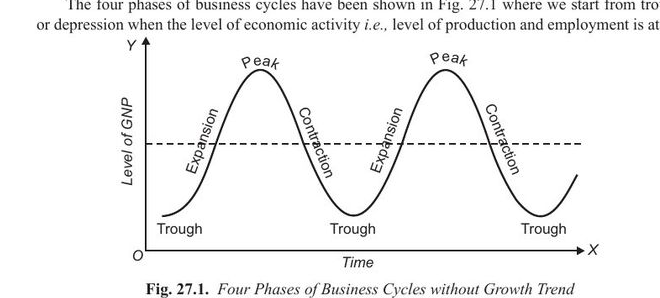
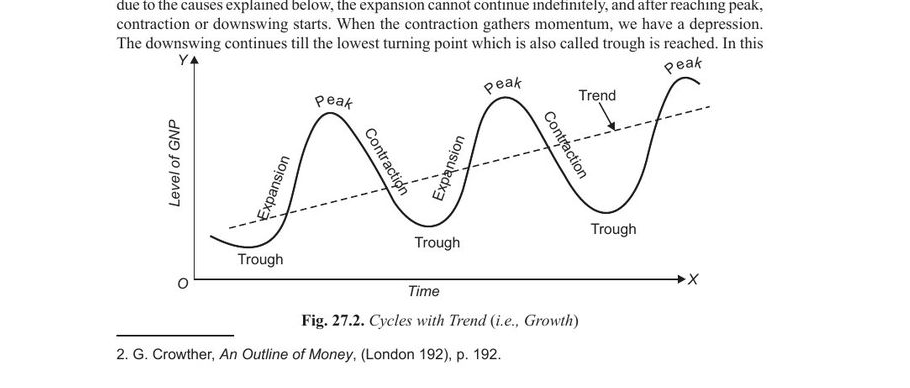
Business cycles show distinct phases, and studying them helps to understand their underlying causes. Generally four phases are distinguished p. 586:
- Expansion (Boom, Upswing or Prosperity)
- Peak (upper turning point)
- Contraction (Downswing, Recession or Depression)
- Trough (lower turning point)
Haberler names the same four phases as (1) Upswing, (2) Upper turning point, (3) Downswing, and (4) Lower turning point.
2The phases explained
| Phase | What happens |
|---|---|
| Expansion & Prosperity | Both output and employment increase until there is full employment of resources and production is at the highest possible level with the given resources. There is no involuntary unemployment — whatever unemployment prevails is only frictional and structural. The gap between potential GNP and actual GNP is zero. A good amount of net investment is occurring and demand for durable consumer goods is high. Prices generally rise, but people enjoy a high standard of living. |
| Peak | The upper turning point. Something occurs to end prosperity — banks may start reducing credit, or profit expectations change adversely and businessmen become pessimistic. Economists differ on the cause: monetarists argue contraction in bank credit causes the downswing; Keynes argued that a sudden collapse of the expected rate of profit (the marginal efficiency of capital), caused by adverse changes in entrepreneurs' expectations, lowers investment and causes the downswing. |
| Contraction & Depression | GNP falls and employment is reduced, so involuntary unemployment appears on a large scale. Investment decreases, causing a further fall in consumption. Prices generally fall due to falling aggregate demand. A significant feature is the fall in the rate of interest, with which people's demand for money holdings increases. There is a lot of excess capacity, as capital-goods and consumer-goods industries work well below capacity. Capital goods and durable consumer goods industries are hit especially hard. Depression occurs when contraction is severe — the depression of 1929–33 is remembered for its great intensity. |
| Trough & Revival | The lowest level of economic activity, which lasts for some time. Capital stock is allowed to depreciate without replacement, and progress in technology makes existing capital obsolete. Revival is stimulated when the banking system starts expanding credit, or when investment activity spurts because of a scarcity of capital arising from non-replacement of depreciated capital and because new technology requires new machines. Recovery is the turning point from depression into expansion. As investment rises it induces an increase in consumption; industries produce more, excess capacity is put to full use, employment increases and unemployment falls — and the cycle is complete. |
3Two patterns of cyclical change
The textbook distinguishes two patterns p. 587:
- Cycles without trend (Fig. 27.1) — fluctuations occur around a stable equilibrium position shown by a horizontal line. This is a case of dynamic stability: change without growth.
- Cycles with trend (Fig. 27.2) — cyclical changes take place around a rising growth path. J. R. Hicks explains this pattern by imposing factors such as autonomous investment due to population growth and technological progress on the otherwise stationary state.
4Simple Explanation
5Exam-Ready Answer
Business cycles show distinct phases, the study of which is useful for understanding their underlying causes. Generally four phases are distinguished: expansion, also called boom, upswing or prosperity; peak, the upper turning point; contraction, also called downswing, recession or depression; and trough, the lower turning point. Haberler named these same phases upswing, upper turning point, downswing and lower turning point. In the expansion phase both output and employment increase until there is full employment of resources and production is at the highest possible level with the given productive resources; there is no involuntary unemployment, whatever unemployment prevails being only of the frictional and structural types, so that the gap between potential and actual GNP is zero, net investment is substantial, and demand for durable consumer goods is high, though prices generally rise. Expansion ends at the peak when something occurs to reverse it: monetarists have argued that a contraction in bank credit causes the downswing, while Keynes argued that a sudden collapse of the expected rate of profit, which he called the marginal efficiency of capital, caused by adverse changes in entrepreneurs' expectations, lowers investment and brings about the downswing. During contraction and depression not only does GNP fall but the level of employment is reduced, so involuntary unemployment appears on a large scale; investment decreases, causing a further fall in consumption, prices generally fall due to the fall in aggregate demand, the rate of interest falls, and there is a great deal of excess capacity as capital-goods and durable consumer-goods industries work far below capacity. At the trough, the lowest level of economic activity, capital stock is allowed to depreciate without replacement and technological progress makes existing capital obsolete; revival then occurs when the banking system starts expanding credit or when investment spurts because of the scarcity of capital caused by non-replacement and the arrival of new technology requiring new machines. Recovery is the turning point from depression into expansion: as investment rises it induces an increase in consumption, industries produce more, excess capacity is put to full use, employment increases, and the cycle is complete. Two patterns of cyclical change may be distinguished — fluctuations around a stable horizontal equilibrium position, which represents change without growth, and fluctuations around a rising growth path, which J. R. Hicks explained by imposing autonomous investment arising from population growth and technological progress on an otherwise stationary state.
6Possible Exam Questions
- Explain the phases of a business cycle with the help of a diagram.
- Describe the features of the depression phase of a business cycle.
- What causes the turning point from prosperity to contraction? Give the monetarist and Keynesian explanations.
- Distinguish between cycles with trend and cycles without trend.
- What is the trough phase? How does revival begin?
7Common Mistakes
- Naming only expansion and contraction. The textbook distinguishes four phases — the two turning points (peak and trough) are phases in their own right.
- Saying there is no unemployment at the peak. There is no involuntary unemployment; frictional and structural unemployment remain.
- Forgetting that the rate of interest falls during depression — a commonly tested detail.
- ENBusiness Cycles Explained in 5 MinutesRyan O'Connell, CFA, FRM
- HI/ENTrade Cycle — Meaning, Types & PhasesMini Sethi
- ENThe Economic Cycle — Stages, Characteristics and CausesEconplusDal
- HIWhat is Business Cycle, Phases of Trade CycleHarsh IAS
3. Causes of Fluctuations Core syllabus concept
1Understand the Concept
What causes business cycles has been, as the textbook puts it, a highly controversial macroeconomic issue p. 7. The main explanations offered are:
| Explanation | Argument |
|---|---|
| Fluctuations in investment (Keynes) | The core Keynesian explanation. It is the changes in private investment that cause fluctuations in aggregate demand, and are therefore responsible for cyclical unemployment. Investment is volatile because it depends on the marginal efficiency of capital — the expected rate of profit — which is governed by entrepreneurs' expectations and can collapse suddenly. |
| Multiplier–accelerator interaction | The textbook states that fluctuations in aggregate demand due to the volatile nature of investment demand, together with the interaction of multiplier and accelerator, provide an adequate explanation of business cycles p. 18. The multiplier shows how a change in investment produces a magnified change in income; the accelerator shows how a change in income/output induces a change in investment. Feeding into each other, they generate self-reinforcing upswings and downswings p. 597. |
| Monetarist explanation | Milton Friedman argued that monetary policy is the prime engine causing fluctuations in economic activity by bringing about changes in aggregate demand, and asserted that monetary policy caused or contributed to almost all recessions he studied. He held that even the Great Depression was primarily caused by the tight monetary policy adopted at the time — an excessive contraction of money supply by the Federal Reserve. Monetarists therefore see the Depression as a failure of government's interventionist policy rather than of the free market p. 11. Contraction in bank credit is likewise offered as a cause of the upper turning point. |
| Changes in expectations | Profit expectations changing adversely, making businessmen pessimistic about the future state of the economy, bring an end to the expansion phase p. 587. |
2The lecture's own list of causes
The Business Cycle lecture deck approaches the same question from a different angle. Rather than naming schools of thought, it lists the kinds of shock that set a cycle off Slide 9. Learn this list too — it is short, it is memorable, and it is the version you were actually taught in class:
| Cause | How it moves the cycle |
|---|---|
| Innovation | A major new technology triggers a wave of investment as firms re-equip; when the wave is spent, investment falls back. |
| Political events | Elections, changes of government and shifts in policy direction alter business confidence and therefore investment plans. |
| Random events and wars | Shocks outside the economic system — conflict, pandemics, natural disasters — abruptly change both demand and supply. |
| Level of consumer spending | Consumption is the largest component of aggregate demand, so a change in household spending moves output directly. |
| Seasonal fluctuations | Regular within-year swings — festival demand, agricultural seasons, holiday retail — which are cyclical but predictable. |
| Cyclical impact differs by good: durable vs non-durable | Purchases of durables (cars, machinery, appliances) can be postponed, so they collapse in a downturn; food and other non-durables cannot be, so they hold up. This is why recessions hit some industries far harder than others. |
Notice that these are compatible with, not alternatives to, the theories above: innovation, political events and random shocks all work through investment and expectations, which is exactly the channel Keynes identified.
3The Great Depression — the case the lecture uses
The deck devotes five slides to the Great Depression Slides 10–14, because it is the extreme case that makes every mechanism visible at once. The US figures it reproduces, comparing 1929 with the 1933 trough Slide 12:
| Indicator (US) | 1929 | 1933 | Change |
|---|---|---|---|
| Unemployment rate | 3.2% | 25.2% | roughly one worker in four |
| Real GNP (1958 $bn) | 203.6 | 141.5 | ≈ −30% |
| Consumption | 139.6 | 112.8 | ≈ −20% |
| Investment | 40.4 | 5.3 | ≈ −87% |
| Money supply | 26.6 | 19.9 | ≈ −25% |
Read the table, and the two rival explanations fall out of it. Investment fell by roughly 87% while consumption fell by only about 20% — that asymmetry is Keynes' case that investment is the volatile component that drives the cycle. But the money supply also fell by about a quarter — and that column is Friedman's case that the Federal Reserve's contraction of money turned a recession into a depression. The lecture also notes that it was the enormous war production of the 1940s — government spending on a scale no peacetime budget had attempted — that finally pulled the US economy out, with unemployment falling to 1.2% Slide 14. That is a fiscal-policy conclusion, and it sets up the next two concepts on this page.
The depression was not confined to the United States: average industrial unemployment rose between 1925–28 and 1929–33 in every country shown — Germany 10.5% → 28.5%, the UK 11.1% → 17.4%, the US 5.1% → 20.2% — while prices fell by 17–48% Slide 13. Falling prices alongside falling output is deflation, the mirror image of the inflation problem.
The course policy's instruction plan assigns Lecture 14 (Causes of Fluctuations) to "T1: Part 5, Chapter 27 pp. 623–" with the end page left blank Policy p. 7. In this printing of Ahuja, p. 623 begins Chapter 27C, "Real Business Cycle Theory" p. 623 — a supply-side account which argues that the major source of cyclical fluctuations is a shift in aggregate supply (a technology shock) rather than in aggregate demand p. 624. It is flagged here so you know exactly what that reference points to and can decide whether to read it. The demand-side explanations above, and the lecture's own list, remain the substance of the topic.
The objective of policy. The textbook is explicit: the objective of macroeconomic policy is to achieve economic stability with equilibrium at the full-employment level of output and income p. 7. It also notes an encouraging result: because of the understanding macroeconomics has provided about business cycles, proper fiscal and monetary policies have been adopted, and the severity of business cycles in recent years has greatly reduced p. 18.
4Exam-Ready Answer
What causes business cycles has been a highly controversial issue in macroeconomics, and several explanations have been offered. The principal Keynesian explanation is that it is changes in private investment that cause fluctuations in aggregate demand and are therefore responsible for cyclical unemployment; investment is volatile because it depends on the marginal efficiency of capital, that is the expected rate of profit, which is governed by entrepreneurs' expectations and can collapse suddenly when those expectations turn adverse. Fluctuations in aggregate demand due to the volatile nature of investment demand, together with the interaction of the multiplier and the accelerator, provide an adequate explanation of business cycles: the multiplier shows how a change in investment brings about a magnified change in income, while the accelerator shows how a change in income and output in turn induces a change in investment, so that the two feed into each other and generate self-reinforcing upswings and downswings. The monetarists, led by Milton Friedman, offer a different explanation, arguing that monetary policy is the prime engine causing fluctuations in economic activity by bringing about changes in aggregate demand; Friedman asserted that monetary policy caused or contributed to almost all the recessions he studied and that even the Great Depression of the 1930s was primarily caused by the tight monetary policy of the time, that is by an excessive contraction of the money supply by the Federal Reserve, so that the Depression revealed the failure not of the free-market system but of the government's own interventionist policy. A contraction in bank credit and an adverse change in profit expectations are also cited as causes of the upper turning point. The objective of macroeconomic policy is to achieve economic stability with equilibrium at the full-employment level of output and income, and it is because of the understanding of business cycles provided by macroeconomics that appropriate fiscal and monetary policies have been adopted, as a result of which the severity of business cycles in recent years has been greatly reduced.
5Possible Exam Questions
- What are the causes of fluctuations in economic activity?
- Explain the Keynesian explanation of business cycles.
- Explain how the interaction of the multiplier and accelerator generates business cycles.
- How do monetarists explain business cycles? How does their view of the Great Depression differ from Keynes'?
6Common Mistakes
- Mixing up multiplier and accelerator. Multiplier: investment → magnified change in income. Accelerator: change in income/output → induced change in investment.
- Presenting only Keynes. The monetarist counter-explanation, especially Friedman on the Great Depression, is a marks-earning contrast.
4. Economic Stabilisation: Fiscal Policy Core syllabus concept
1Understand the Concept
The economy does not always work smoothly. At times it is in the grip of recession, with national income, output and employment far below potential, idle productive capacity and rising unemployment; at other times it is "overheated", meaning inflation. Classical economists believed an automatic mechanism would restore stability, but the evidence of the 1930s and the post-war period shows no such automatic mechanism works — which is why Keynes argued for government intervention p. 627.
Three goals of macroeconomic policy:
- Economic stability at a high level of output and employment
- Price stability
- Economic growth
Keynes considered monetary policy ineffective for lifting an economy out of depression and emphasised fiscal policy; modern economists hold that both play a useful role.
2Discretionary Fiscal Policy
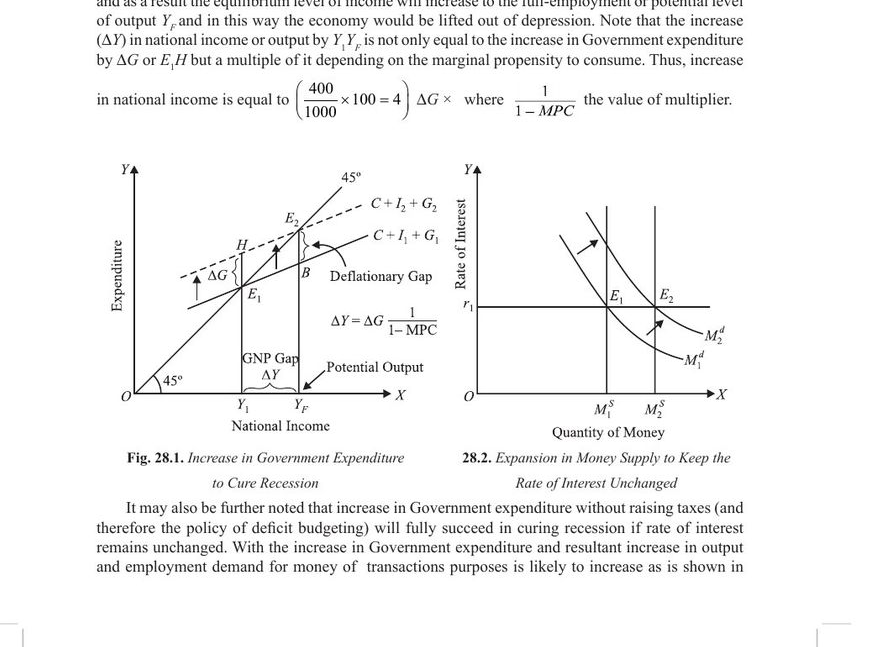
Discretionary fiscal policy means a deliberate change in government expenditure and taxes to influence the level of national output and prices. Fiscal policy generally aims at managing aggregate demand p. 628.
| Situation | Policy | Budget position |
|---|---|---|
| Recession | Expansionary fiscal policy: increase government expenditure, and/or cut taxes | Budget deficit |
| Inflation | Contractionary fiscal policy: reduce government expenditure, and/or raise taxes | Budget surplus (or reduced deficit) |
How an increase in government expenditure cures recession. The government starts public works — building roads, dams, ports, telecommunication links, irrigation works, electrification. The effect is both direct and indirect. The direct effect is the increase in incomes of those who supply materials and labour for these projects, along with the increase in output. The indirect effect is the working of the multiplier: those who get more income spend it on consumer goods according to their marginal propensity to consume; since there is excess capacity in consumer goods industries during recession, the increased demand expands their output, which generates further employment and income, and the process repeats until it exhausts itself. How large the increase must be depends on the magnitude of the GNP gap and the size of the multiplier, which in turn depends on the MPC p. 629.
3Non-Discretionary Fiscal Policy: Automatic Stabilisers
Discretionary policy suffers from lags — in recognising the problem and in taking action. The alternative is non-discretionary fiscal policy, in which the tax structure and expenditure pattern are so designed that taxes and government spending vary automatically in the appropriate direction with changes in national income, without any special deliberate action by the government or parliament. These are called automatic or built-in stabilisers p. 634.
| Stabiliser | How it works |
|---|---|
| Personal income taxes | Progressive rates mean that as national income rises during expansion and inflation, an increasing percentage of income is paid to the government, reducing disposable income, consumption and aggregate demand — checking inflation. When income falls in recession, tax revenue falls too, preventing aggregate demand from falling proportionately. |
| Corporate income taxes | Corporate tax rates are generally higher at higher profit levels. Since recession and inflation affect corporate profits greatly, revenue rises sharply in boom (reducing demand) and falls sharply in recession (offsetting the decline in demand), giving a powerful stabilising effect. |
| Transfer payments (unemployment compensation, welfare benefits) | When recession raises unemployment, the government must spend more on unemployment compensation and welfare programmes such as food stamps, rent subsidies and farm subsidies, making the recession shorter and less intense. In boom, unemployment falls and the government curtails these programmes, lowering expenditure and helping control inflation. |
| Corporate dividend policy | Corporations follow a fairly stable dividend policy rather than raising and cutting dividends in step with profits. This lets individuals spend more during recession and less during boom than they otherwise would, cushioning recession and curbing inflation by stabilising consumption. |
Important limitation: automatic stabilisers reduce the intensity of fluctuations but cannot alone correct recession and inflation significantly. According to an estimate for the U.S.A., automatic stabilisers reduced fluctuations in national income only by about one-third. Discretionary fiscal policy is therefore still required p. 635.
4Crowding-Out Effect
Critics of Keynesian theory point out that the expansionary effect of fiscal policy is not as large as Keynesians suggest. When the government increases expenditure without raising taxes (or cuts taxes without cutting expenditure), it must borrow to finance the deficit; this increases the demand for loanable funds and raises the rate of interest, which discourages private investment. Thus government borrowing "crowds out" some private investment, so the net expansionary effect on output and employment is smaller p. 635, p. 9.
5The four instruments of fiscal policy — as your lecture frames them
The textbook discusses fiscal policy as demand management. Your lecture deck approaches it from the government's side of the table, in the Indian context: fiscal policy is related to the income and expenditure of the government, and means any decision to change the level, composition or timing of government spending, or to change the rate and structure of tax Slide 6. Its objectives are the same as those of monetary policy. On that framing there are four instruments:
| Instrument | What it is, and how it is used |
|---|---|
| 1. Public expenditure Slide 8 | Public expenditure influences economic activity very greatly, and is of two kinds — developmental and non-developmental. Developmental activity needs capital on a scale the private sector alone cannot supply, which is why substantial public expenditure is required. It is made in four main ways: (i) development of state enterprises, (ii) support to the private sector, (iii) development of infrastructure, and (iv) social welfare. |
| 2. Taxation Slide 9 | Taxes are the main source of government revenue; India levies both direct and indirect taxes. The main objectives of taxation policy are the mobilisation of resources, the promotion of saving, and bringing about equality of income and wealth. |
| 3. Public debt Slide 10 | No government can mobilise all the funds needed for economic development through tax alone, so it resorts to borrowing. Public debt is of two kinds: internal debt (borrowed within the country) and external debt (borrowed from abroad). |
| 4. Deficit financing Slide 11 | Financing the budgetary deficit — the excess of government expenditure over government income — by taking loans from the Reserve Bank of India. This is the most expansionary of the four, and also the most inflationary, since it adds directly to the money supply. |
Connect this back to the textbook: instruments 1 and 2 are exactly the "government expenditure and taxes" of discretionary fiscal policy above; instruments 3 and 4 are the two ways of paying for a deficit budget — and the choice between them matters, because borrowing from the open market is what produces the crowding-out effect, while borrowing from the central bank does not crowd out private investment but is inflationary instead. Ahuja's Ch. 28 review question 14 asks exactly this comparison p. 637.
6Exam-Ready Answer
The economy does not always work smoothly: at times it is in the grip of recession, when national income, output and employment are far below their potential levels and there is idle productive capacity together with unemployment of labour, and at other times it is overheated, meaning that inflation occurs. Classical economists believed that an automatic mechanism would cure recession and control inflation, but the experience of the severe depression of the 1930s and of the post-war period shows that no such automatic mechanism works, which is why Keynes argued for intervention by the government through appropriate macroeconomic policy. The three goals of macroeconomic policy are economic stability at a high level of output and employment, price stability, and economic growth. Fiscal policy, which is an important instrument for stabilising the economy, is of two kinds. Discretionary fiscal policy means a deliberate change in government expenditure and taxes to influence the level of national output and prices, and is therefore mainly a policy of demand management. At times of recession the government increases its expenditure or cuts taxes, or both, so that expansionary fiscal policy to cure recession is a deficit budget policy; to control inflation the government reduces expenditure or raises taxes, planning for a budget surplus. An increase in government expenditure on public works such as roads, dams, ports and irrigation works has a direct effect in raising the incomes of those who supply materials and labour, and an indirect effect through the working of the multiplier, as those who receive higher incomes spend them on consumer goods according to their marginal propensity to consume; how large the increase in expenditure needs to be depends on the magnitude of the GNP gap and on the size of the multiplier. Non-discretionary fiscal policy, or automatic stabilisers, consists of a tax structure and expenditure pattern so designed that taxes and government spending vary automatically in the appropriate direction with changes in national income, without any deliberate action; the important automatic stabilisers are progressive personal income taxes, corporate income taxes, transfer payments such as unemployment compensation and welfare benefits, and stable corporate dividend policy. Automatic stabilisers reduce the intensity of both recession and inflation, but they cannot alone correct them significantly — according to an estimate for the United States they reduced fluctuations in national income only by about one-third — so discretionary fiscal policy remains necessary. It must also be noted that when the government borrows to finance a budget deficit, the increased demand for loanable funds raises the rate of interest and discourages private investment, so that government borrowing crowds out some private investment and the net expansionary effect of fiscal policy is smaller than it would otherwise be.
Stated in terms of the government's own accounts, fiscal policy operates through four instruments. The first is public expenditure, which may be developmental or non-developmental, and which is undertaken through the development of state enterprises, support to the private sector, the development of infrastructure, and social welfare. The second is taxation, both direct and indirect, whose main objectives are the mobilisation of resources, the promotion of saving, and bringing about greater equality of income and wealth. The third is public debt, resorted to because no government can mobilise through taxation alone all the funds needed for economic development, and which may be internal or external. The fourth is deficit financing, that is financing the budgetary deficit — the excess of government expenditure over government income — by taking loans from the Reserve Bank of India; this is the most expansionary of the four but also the most inflationary, since it adds directly to the money supply.
7Possible Exam Questions
- What is fiscal policy? Explain how it is used to cure recession and to control inflation.
- Distinguish between discretionary and non-discretionary fiscal policy.
- What are automatic or built-in stabilisers? Explain the important ones.
- Explain the crowding-out effect. How does it limit the effectiveness of fiscal policy?
- What are the goals of macroeconomic policy?
- Explain the instruments of fiscal policy — public expenditure, taxation, public debt and deficit financing.
- Distinguish between developmental and non-developmental public expenditure.
- What is deficit financing? How does it differ from financing a deficit by open-market borrowing, and which is more inflationary?
8Common Mistakes
- Getting the budget position backwards. Recession → deficit budget (spend more/tax less); inflation → surplus budget.
- Claiming automatic stabilisers can fully stabilise the economy — the textbook gives the one-third figure precisely to refute that.
- Omitting the multiplier when explaining how increased government expenditure cures recession; the multiplier is the indirect effect.
5. Economic Stabilisation: Monetary Policy Core syllabus concept
1Understand the Concept
Monetary policy is the other major instrument of stabilisation, operated by the central bank. In times of recession or depression, expansionary monetary policy (also called easy money policy) is adopted to raise aggregate demand and stimulate the economy. In times of inflation and excessive expansion, contractionary monetary policy (also called tight money policy) is adopted to control inflation and achieve price stability by reducing aggregate demand p. 639.
The definition to open an answer with. Your lecture deck defines it in the Indian context: monetary policy in India is formulated and executed by the Reserve Bank of India, and is a discretionary act undertaken by the authorities designed to influence (a) the supply of money, (b) the cost of money — that is, the rate of interest, and (c) the availability of money, in order to achieve specific objectives Slide 2. Its main elements are that it regulates the stock and growth rate of the money supply; it regulates the entire banking system of the economy; it regulates the level and structure of interest rates, directly in the organised sector and indirectly in the unorganised sector; and it determines the allocation of loans among different sectors.
That three-part statement — supply, cost and availability of money — is worth memorising verbatim. It also tells you why there are two families of instruments: the quantitative tools below act on the supply and cost of money, while selective credit controls act on its allocation between sectors.
2Expansionary Monetary Policy to Cure Recession
Three measures are adopted p. 639:
- Open market operations — buying securities. The central bank buys securities in the open market from the public, chiefly from commercial banks. This increases the reserves of banks or the currency held by the public; with greater reserves banks can issue more credit to investors and businessmen for investment, shifting the aggregate demand curve upward.
- Lowering the bank rate (discount rate) — the rate of interest charged by the central bank on its loans to commercial banks. At a lower bank rate commercial banks borrow more from the central bank and can issue more credit at lower interest to businessmen, making credit both cheaper and more available, which raises investment demand, output and income.
- Reducing the Cash Reserve Ratio (CRR). In countries like India this is a more effective and direct way of expanding credit. With lower reserve requirements, a large amount of funds is released for lending, so credit expands and investment increases. The textbook's example: in April 1996, when the Reserve Bank lowered CRR from 14% to 13%, it was estimated this would release about ₹5,000 crores for banks.
Statutory Liquidity Ratio (SLR). In addition to CRR, Indian banks must keep a minimum proportion of deposits in specified liquid assets such as government securities. Lowering the SLR increases banks' lendable resources and hence credit availability for the private sector.
All these tools work by increasing reserves or liquid resources with banks, which are the basis on which banks expand credit; the increase in reserves raises money supply, increases the availability of credit and lowers its cost, leading to more private investment spending p. 640.
3Tight Monetary Policy to Control Inflation
To control inflation the reverse measures are used p. 9–10, p. 641: the rate of interest is raised and availability of credit reduced; the cash reserve ratio is raised; and government bonds and securities are sold to banks and the public. When interest rates rise, businessmen and households find borrowing more costly, which discourages demand for credit and contracts money supply. The decrease in credit for investment and consumption causes a decline in aggregate demand, exerting downward pressure on prices.
A fourth instrument named by the textbook is selective credit controls, used to direct credit towards or away from particular sectors.
4Keynes' Scepticism and the Liquidity Trap
An important qualification. Keynes was not optimistic about the efficacy of monetary policy to tackle depression and unemployment p. 10. He argued that:
- Demand for money at the time of depression is highly interest-elastic, so an expansion in money supply will not lower the interest rate significantly — the situation known as the liquidity trap p. 644.
- Investment demand is not much interest-elastic, so even a lower interest rate will not stimulate investment much.
This is why Keynes emphasised fiscal policy over monetary policy for curing depression. The monetarist view is the opposite: Friedman held that monetary policy is the prime engine of fluctuations, and monetarists advocate not discretionary action but a constant, stable rate of growth of money supply, since they believe a free-market economy is inherently stable p. 11, p. 645.
5Simple Explanation
6Exam-Ready Answer
Monetary policy refers to the policies regarding the growth of money supply, the availability of credit and the interest or cost of credit, and is used by the central bank to achieve the objectives of price stability, full employment and economic growth. In India it is formulated and executed by the Reserve Bank of India, and may be defined as a discretionary act undertaken by the authorities designed to influence the supply of money, the cost of money or rate of interest, and the availability of money, in order to achieve specific objectives; its main elements are that it regulates the stock and growth rate of the money supply, regulates the entire banking system of the economy, regulates the level and structure of interest rates directly in the organised sector and indirectly in the unorganised sector, and determines the allocation of loans among different sectors. In times of recession or depression an expansionary monetary policy, also called an easy money policy, is adopted to raise aggregate demand and stimulate the economy, while in times of inflation a contractionary or tight money policy is adopted to reduce aggregate demand and achieve price stability. Three principal measures constitute expansionary monetary policy. First, the central bank undertakes open market operations and buys securities from the public and chiefly from commercial banks, which increases the reserves of banks so that they can issue more credit for investment. Second, the central bank lowers the bank rate or discount rate, which is the rate charged on its loans to commercial banks, so that banks borrow more and can issue credit at a lower rate of interest, making credit both cheaper and more available. Third, the central bank reduces the cash reserve ratio, which in countries such as India is a more effective and direct way of expanding credit, since lower reserve requirements release a large volume of funds for lending; similarly, lowering the statutory liquidity ratio increases the lendable resources of banks. All these tools increase reserves with the banks, which are the basis on which banks expand credit, thereby raising money supply, increasing the availability of credit and lowering its cost, and so stimulating private investment. To control inflation the opposite measures are taken: the rate of interest is raised, the availability of credit reduced, the cash reserve ratio raised, and government bonds and securities sold to banks and the public, so that borrowing becomes costlier, credit contracts, aggregate demand declines and downward pressure is exerted on prices; selective credit controls may also be used. It must be noted, however, that Keynes was not optimistic about the efficacy of monetary policy in tackling depression, arguing that the demand for money at such times is highly interest-elastic so that an expansion in money supply will not lower the rate of interest significantly, and that investment demand is not much interest-elastic so that even a lower rate of interest will not stimulate investment appreciably. This is why he emphasised fiscal policy instead. The monetarists, in contrast, hold that monetary policy is the prime engine causing fluctuations in economic activity, and rather than discretionary action they advocate a constant and stable rate of growth of the money supply.
7Possible Exam Questions
- What is monetary policy? Explain the instruments of monetary policy.
- Explain expansionary monetary policy to cure recession.
- How is tight monetary policy used to control inflation?
- Why was Keynes sceptical about the effectiveness of monetary policy in curing depression?
- Compare the Keynesian and monetarist views on monetary policy.
- Distinguish between CRR and SLR.
8Common Mistakes
- Confusing the direction of open market operations. To expand money supply the central bank buys securities; to contract it sells them.
- Mixing up CRR and SLR. CRR = proportion of deposits kept as cash reserves with the central bank; SLR = proportion kept in specified liquid assets such as government securities.
- Presenting monetary policy as always effective. Keynes' two elasticity objections and the liquidity trap are exactly the qualification examiners look for.
- ENWhat is Monetary Policy? Repo Rate, CRR, SLR, Expansionary Monetary PolicyStudyIQ IAS
- ENCRR, SLR, Repo Rate & Reverse Repo Explained in 10 MinutesLearn Economics with Anjuli
- HI/ENRepo, CRR, SLR, Bank Rate Explained | Monetary PolicyStudyIQ IAS
- HI/ENHow RBI works? Complete Monetary Policy of RBIStudyIQ IAS