Unit 01 — Nature and Scope of Macroeconomics
What macroeconomics is, why it exists as a separate study, the six issues it deals with, and the government's role in the macroeconomy.
1. What Is Macroeconomics? Core syllabus concept
1Understand the Concept
Microeconomics deals with the analysis of small individual units of an economy — individual consumers, individual firms, individual industries and markets — and explains how prices of products and factors are determined, how resources are allocated among various products, and how income is distributed among factors p. 3.
Macroeconomics, by contrast, is concerned with the analysis of the behaviour of the economic system in totality. It studies how the large aggregates — total employment, national product or national income, and the general price level — are determined. Macroeconomics is therefore a study of aggregates. It also explains how the productive capacity and national income of a country increase over time in the long run.
Professor Gardner Ackley draws the distinction sharply: "Macroeconomics concerns itself with such variables as the aggregate volume of the output of an economy, with the extent to which its resources are employed, with the size of the national income, with the 'general price level'. Microeconomics, on the other hand, deals with the division of total output among industries, products and firms and the allocation of resources among competing uses."
So the subject matter of macroeconomics is to explain what determines the level of total economic activity (the size of national income and employment) and fluctuations in it in the short run; what causes the general price level to rise and determines the rate of inflation; and what determines the increase in productive capacity and national income in the long run — the problem of economic growth p. 4.
2Simple Explanation
3Example
Why is national income higher today than it was in 1950? Why does the rate of unemployment in a free market economy go up in one period and fall in another? Why do some countries have high rates of inflation while others maintain price stability? What causes alternating periods of depression and boom? Why should government intervene in the economy, and what policy should it adopt to check inflation, control business cycles, raise national income, reduce unemployment and restore equilibrium in the balance of payments?
4The Origin: Great Depression and the Keynesian Revolution
Beginning in late 1929, capitalist economies experienced a severe depression which created large involuntary unemployment and a sharp fall in GDP, caused by a drastic decline in private investment. In the United States, 1.5 million workers were unemployed in 1929; by 1933 this had risen to 13 million out of a labour force of 51 million — around 25 per cent p. 4.
Classical economists assumed full employment always prevailed, based on Say's Law of Markets: supply creates its own demand, so the problem of lack of demand does not arise — the factors producing goods get rewards (wages, interest, rent) which become expenditure on those goods. A.C. Pigou argued the unemployment of the 1930s was due to obstacles put up by trade unions and government, and could be eliminated by cutting wages.
J.M. Keynes challenged this. He pointed out that while a wage cut may expand employment in an individual industry, reducing wages throughout the economy lowers workers' incomes and therefore aggregate demand — which would lower employment rather than expand it. In A General Theory of Employment, Interest and Money (1936) he showed that equilibrium income and employment are determined by aggregate demand and aggregate supply, and that due to deficient aggregate effective demand, equilibrium might be established well below full employment. This break was so fundamental it earned the names Keynesian Revolution and New Economics p. 5.
5Where macroeconomics sits, and what it contains
Your lecture deck opens with two structural diagrams that are worth reproducing in an answer whenever a question asks you to place macroeconomics rather than just define it Slide 2.
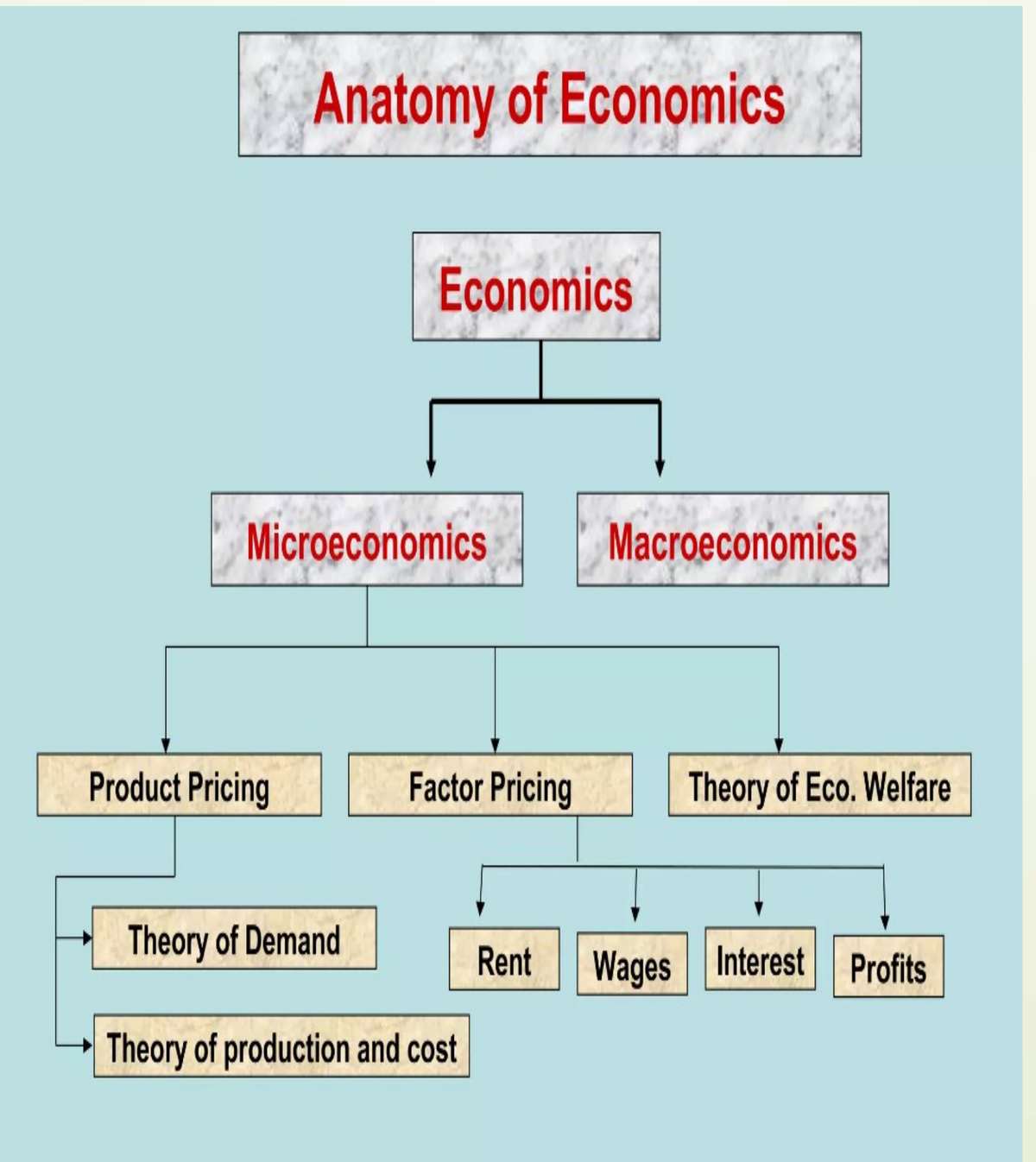
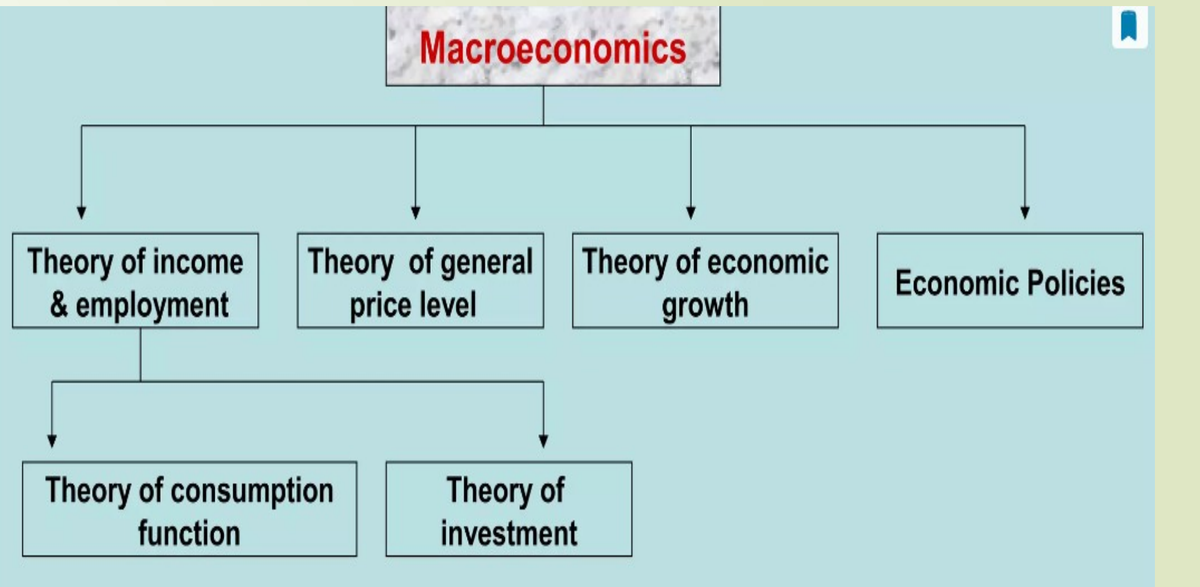
Read the second diagram as a map of your own syllabus. Theory of income and employment, and beneath it the theory of the consumption function and the theory of investment, is Unit 2. Theory of the general price level is the inflation portion of Unit 3. Economic policies is Unit 3's fiscal and monetary policy. Saying this in an answer shows you understand the subject's structure, not just its definition.
6Nature and evolution of macroeconomics
Three points on the nature of the subject, from the deck Slide 4:
- Macroeconomics is relatively a new branch of economics — a full-fledged macroeconomics appeared only after the publication of Keynes' General Theory of Employment, Interest and Money in 1936.
- It is more normative by nature, unlike a purely positive science — it does not only describe what is, it prescribes what policy should be.
- It is both a theoretical and a policy science.
And the evolution of the subject in three stages — a compact answer to "trace the development of macroeconomic thought":
| School | Period | Position |
|---|---|---|
| Classical and Neo-Classical | 1776–1930 | Most classical theory was built on a micro foundation; macroeconomics had not developed as a separate branch of economics. |
| Keynesian | 1930s–1960s | The publication of the General Theory laid the foundation of modern macroeconomics. |
| Post-Keynesian | early 1970s onwards | Monetarism — the shift from demand management to monetary management. New Classical School — emphasises the role of individuals' rational expectations. New Keynesian School — problems of information and the cost of changing prices lead to price rigidities, which cause fluctuations in output and employment. |
The textbook's Ch. 1 review question 8 asks you to explain monetarism, supply-side economics and rational expectations theory and say how they differ from the Keynesian model p. 18 — this table is the skeleton of that answer.
7Goals and indicators — the lecture's framing
Three macroeconomic goals Slide 5:
- Full employment — the situation in which all available resources (labour, capital, land and entrepreneurship) are used to produce goods and services. It enables more production and so reduces the scarcity problem.
- Stability — avoiding or limiting fluctuations in production, employment and prices. It reduces uncertainty about the future.
- Growth — increasing the economy's ability to produce goods and services. It improves living standards and further addresses scarcity.
Six key indicators of economic activity — the numbers a macroeconomist actually watches Slide 6:
- Real Gross Domestic Product
- The unemployment rate
- The inflation rate
- The interest rate
- The level of the stock market
- The exchange rate
Useful pairing: the three goals tell you what policy is for; the six indicators tell you how you would know whether it worked. Full employment is read off the unemployment rate, stability off the inflation rate, and growth off real GDP.
8Important Points
- Macroeconomics = analysis of the behaviour of the economic system in totality; a study of aggregates.
- Key aggregates: total employment, national product/national income, general price level.
- It explains the level of economic activity, short-run fluctuations in it, inflation, and long-run growth.
- Origin: the Great Depression (1929–33) exposed the failure of the classical full-employment assumption.
- Say's Law: supply creates its own demand — the classical basis for denying involuntary unemployment.
- Keynes (1936) showed a free-market economy is not self-correcting and government intervention may be needed.
9Exam-Ready Answer
Whereas microeconomics deals with the analysis of small individual units of an economy such as individual consumers, firms, industries and markets, and explains how prices of products and factors are determined and how resources are allocated, macroeconomics is concerned with the analysis of the behaviour of the economic system in totality. It studies how large aggregates such as total employment, national product or national income, and the general price level are determined, and is therefore a study of aggregates. As Gardner Ackley put it, macroeconomics concerns itself with the aggregate volume of output of an economy, the extent to which its resources are employed, the size of national income and the general price level, whereas microeconomics deals with the division of total output among industries, products and firms and the allocation of resources among competing uses. The subject matter of macroeconomics is therefore to explain what determines the level of total economic activity and fluctuations in it in the short run, what causes the general price level to rise and determines the rate of inflation, and what determines the increase in productive capacity and national income in the long run, which is the problem of economic growth. Modern macroeconomics originated in the Great Depression beginning in 1929, when unemployment in the United States rose to about 25 per cent of the labour force. Classical economists, relying on Say's Law of Markets that supply creates its own demand, denied that involuntary unemployment could persist. J.M. Keynes challenged this in his General Theory of Employment, Interest and Money (1936), showing that equilibrium income and employment are determined by aggregate demand and aggregate supply and that, due to a deficiency of aggregate effective demand, equilibrium may be established well below the full-employment level — a change in economic thinking so fundamental that it is known as the Keynesian Revolution.
10Possible Exam Questions
- What is macroeconomics? How will you distinguish it from microeconomics? (textbook Question for Review 1)
- In what sense did Keynes bring about a revolution in economics? (textbook Question for Review 4)
- Macroeconomics has been described as a study of aggregates. Name some important aggregates whose behaviour is analysed in macroeconomics. (textbook Question for Review 5)
- State and explain Say's Law of Markets. Why did Keynes reject it?
11Common Mistakes
- Defining macroeconomics as "the study of big things" — the precise phrasing is the behaviour of the economic system in totality, i.e. a study of aggregates.
- Saying Keynes proved wage cuts never increase employment. His point is narrower and sharper: a wage cut works for one industry but not for the whole economy, because economy-wide wages are also incomes.
- Attributing Say's Law to Keynes — it is the classical position Keynes attacked.
- ENNature of Microeconomics and MacroeconomicsNCERT OFFICIAL
- ENMicro and Macro Economics: A Comparison — in 5 minutesKognito Key
- HI/ENNature and Scope of Macroeconomics (Unit 1)Chauhan Institute
2. Major Issues and Concerns of Macroeconomics Core syllabus concept
1Understand the Concept
After Keynes, macroeconomics widened well beyond income and employment. The textbook identifies six major issues whose analysis "describes the scope of macroeconomics" p. 5:
| # | Issue | What it asks |
|---|---|---|
| 1 | Unemployment | What determines the level of employment and national income, and therefore what causes involuntary unemployment? Keynes: with aggregate supply fixed in the short run, it is deficiency of aggregate demand that causes underemployment equilibrium. |
| 2 | Recession & determination of national income (GNP) | National income shows the performance of the economy and the overall living standards. Recession causes actual national income to fall below its potential level. |
| 3 | Inflation | Classical view: price level is determined by the quantity of money. Keynes: just as unemployment is caused by deficiency of aggregate demand, inflation is due to excessive aggregate demand — the demand-pull theory. Later, cost-push and structuralist theories were added. |
| 4 | Business cycles | Fluctuations in output and employment with alternating periods of boom and recession. Severe recessions are called depressions. Covered in Unit 3. |
| 5 | Stagflation | In the 1970s, recession/stagnation co-existed with both high unemployment and rapid inflation. Keynesian demand-side theory could not explain it, prompting supply-side economics. In India, the term is used for slowdown in growth along with high inflation. |
| 6 | Economic growth | Sustained increase in national income or per capita income over a long period. Depends on growth of physical capital, human capital and technology — all requiring saving and investment. Harrod and Domar extended Keynes to the long run. |
A seventh concern the textbook treats alongside these is the balance of payments and exchange rate — the record of economic transactions of residents with the rest of the world, and the rate at which a country's currency exchanges for foreign currencies. Instability in the exchange rate has been a major problem in recent years p. 8.
Note also the textbook's distinction between economic growth and economic development: development is the more inclusive concept — apart from a rise in income, poverty, unemployment and inequality must also be declining. Amartya Sen adds that freedom from undernourishment, illiteracy and illness, and the building of the capabilities of the poor, are essential requirements of development p. 8.
2Simple Explanation
3Important Points
- Six issues: unemployment · recession & national income · inflation · business cycles · stagflation · economic growth. (Plus balance of payments & exchange rate.)
- Keynes' symmetry: deficient aggregate demand → unemployment; excessive aggregate demand → inflation (demand-pull).
- Stagflation = stagnation + inflation together; it broke the Keynesian demand-side explanation and gave rise to supply-side economics.
- Growth ≠ development. Development also requires falling poverty, unemployment and inequality (Sen: expansion of capabilities and freedoms).
- In developing countries like India, supply-side factors (physical capital, human capital, technology) matter more in determining national income than aggregate demand alone.
4Exam-Ready Answer
The analysis of six major issues describes the scope of macroeconomics. The first is the problem of unemployment: explaining what determines the level of employment and national income and therefore what causes involuntary unemployment. Keynes explained that with the aggregate supply curve remaining unchanged in the short run, it is the deficiency of aggregate demand that causes underemployment equilibrium, and that changes in private investment cause the fluctuations in aggregate demand responsible for cyclical unemployment. The second is recession and the determination of national income or GNP, which shows the performance of the economy and determines the overall living standards of the people; recession causes the actual level of national income to fall below its potential level. The third is inflation. Classical economists held that the quantity of money determined the general price level, but Keynes argued that just as unemployment and depression were caused by a deficiency of aggregate demand, inflation was due to excessive aggregate demand, putting forward what is now called the demand-pull theory of inflation; cost-push and structuralist theories were developed later. The fourth is business cycles, that is, fluctuations in output and employment with alternating periods of boom and recession, severe recessions being called depressions. The fifth is stagflation, the more intricate problem experienced in the 1970s in which recession and high unemployment co-existed with rapid inflation; because this could not be explained by Keynesian demand-side theory, a new school called supply-side economics emerged. The sixth is economic growth, meaning a sustained increase in national income or per capita income over a long period, which depends on the growth of physical capital, human capital and technological progress and therefore on the rates of saving and investment. To these is often added the problem of the balance of payments and the exchange rate, since instability in exchange rates has become a serious concern in recent years.
5Possible Exam Questions
- What are the important problems that constitute the subject matter of macroeconomics? Briefly explain them. (textbook Question for Review 2)
- What is stagflation? Why could Keynesian theory not explain it?
- Distinguish between economic growth and economic development.
- Explain the demand-pull theory of inflation put forward by Keynes.
6Common Mistakes
- Listing the six issues without explaining any — the marks are in the one-line explanation of each.
- Treating stagflation as just "high inflation". Its defining feature is high inflation together with recession and high unemployment.
- Using growth and development interchangeably.
3. Why a Separate Study? Macroeconomic Paradoxes Core syllabus concept
1Understand the Concept
Why can't we just add up microeconomics? Because in the economic system what is true of the parts is not necessarily true of the whole. Applying a micro-approach to generalise about the whole economy is incorrect and may lead to misleading conclusions p. 14.
When laws that hold for individual parts are invalid for the whole, paradoxes appear. Boulding calls these macroeconomic paradoxes, and it is these paradoxes "more than any other factor, which justify the separate study of the system as a whole." Boulding's analogy: the economy is a forest and individual firms are trees — a forest is an aggregation of trees but does not reveal the same properties or behaviour as the individual trees, so it is misleading to apply the rules governing individual trees to the forest p. 15.
Paradox of Thrift. Saving is generally good for an individual — for old age, children's education, buying durables, or earning future income. But when all people try to save more, they are actually unable to do so, and the attempt causes their income to decline. Keynes explained: efforts to save more, especially during depression, lower consumption demand and therefore aggregate demand; falling aggregate demand causes national output and income to fall and unemployment to rise; at the lower income level savings fall back to the original level, but consumption is now less than before — so people end up worse off. Thus at times of depression, more saving deepens the crisis.
Wage-Employment Paradox. Given the demand curve for labour, an individual industry will employ more men at a lower wage — a commonplace conclusion of microeconomics. But if wages are cut all round, aggregate demand for goods and services declines, since wages are the incomes of the workers who form the majority. Because the demand for labour is a derived demand, the fall in aggregate demand for goods causes demand for labour to fall — creating more unemployment rather than reducing it.
This is the fallacy of composition: what is true of individual components is not true of the collective whole. The textbook gives further instances: an individual may save more than he invests, but for the economy as a whole actual savings are always equal to actual investment; an individual's expenditure may differ from his income, but national expenditure must equal national income; at full employment an individual industry can expand output by bidding workers away from other industries, but the economy cannot p. 16.
Importantly, this does not make microeconomics worthless — the two are complementary, not competitive. As Samuelson put it: "There is really no opposition between micro- and macroeconomics. Both are absolutely vital. And you are only half-educated if you understand the one while being ignorant of the other."
2Simple Explanation
3Important Points
- What is true of the parts is not necessarily true of the whole → fallacy of composition.
- Boulding's forest-and-trees analogy; he named these macroeconomic paradoxes.
- Paradox of thrift: all saving more → lower aggregate demand → lower income → saving falls back, consumption is lower, people are worse off.
- Wage-employment paradox: all-round wage cut → lower incomes → lower aggregate demand → labour demand (a derived demand) falls → more unemployment.
- Other whole-economy identities: actual saving ≡ actual investment; national expenditure ≡ national income.
- Micro and macro are complementary (Samuelson).
4Exam-Ready Answer
A separate macroeconomic analysis is necessary because the behaviour of the economic system as a whole is not merely a matter of adding, multiplying or averaging what happens in the individual parts: in the economic system, what is true of the parts is not necessarily true of the whole. When laws or generalisations that hold good for constituent individual parts are untrue and invalid for the whole economy, paradoxes appear, which Boulding called macroeconomic paradoxes, and it is these paradoxes more than any other factor that justify the separate study of the system as a whole. Boulding likened the economic system to a forest and individual firms to trees: a forest is an aggregation of trees but does not reveal the same properties and behaviour pattern as the individual trees, so it would be misleading to apply the rules governing individual trees to generalise about the forest. Two examples illustrate this. The paradox of thrift arises because although saving is good for an individual, when all people in a society try to save more they are actually unable to do so, and the attempt causes their income to decline; efforts to save more, especially at times of depression, lower consumption demand and therefore aggregate demand, causing national output and income to fall and unemployment to increase, so that at the lower level of income savings return to their original level while consumption is lower than before, leaving people worse off. The wage-employment paradox arises because although an individual industry will employ more labour at a lower wage, if wages are cut throughout the economy the aggregate demand for goods and services declines, since wages are the incomes of workers who constitute the majority; as the demand for labour is a derived demand, the fall in aggregate demand for goods reduces the demand for labour and creates more unemployment rather than less. This general phenomenon is called the fallacy of composition. It should not be concluded that microeconomics is worthless; the two are complementary rather than competitive, and as Samuelson observed, one is only half-educated if one understands the one while being ignorant of the other.
5Possible Exam Questions
- What are macroeconomic paradoxes? Explain any two of them. Explain how these paradoxes limit the applicability of microeconomic theories to explain the behaviour of the economy as a whole. (textbook Question for Review 3)
- Explain the paradox of thrift. Why does saving more deepen a depression?
- What is the fallacy of composition? Illustrate with the wage-employment relationship.
6Common Mistakes
- Stating the paradox of thrift as "saving is bad". The textbook's claim is conditional — it is at times of depression that more saving deepens the crisis.
- Forgetting to say why the wage paradox works: labour demand is a derived demand, derived from demand for goods.
- Concluding that microeconomics is invalid — the textbook explicitly says the two are complementary.
4. Importance of Macroeconomics & Business Decisions Core syllabus concept
1Understand the Concept
The textbook sets out why studying macroeconomics matters pp. 16–18:
- To understand the working of the macroeconomy. We cannot derive the laws governing national income, total employment and the general price level from the microeconomic decisions of individual consumers and firms — the macroeconomic paradoxes prove this.
- The important nature of macroeconomic issues. Problems like unemployment, inflation and exchange-rate instability cause real human suffering. Unemployment creates misery and social evils and wastes economic resources; inflation erodes real incomes, redistributes income in favour of the rich, and pushes more people below the poverty line.
- Accelerating economic growth. Macroeconomics explains what determines growth. Harrod-Domar and Solow models reveal that the rate of saving and investment and improvements in technology are the important determinants.
- Understanding business cycles. Fluctuations in aggregate demand due to volatile investment, together with the interaction of multiplier and accelerator, provide an adequate explanation — and this understanding has helped adopt fiscal and monetary policies that have greatly reduced the severity of business cycles.
- Formulating government macroeconomic policies. With knowledge of the causes of recession and inflation, governments design fiscal and monetary policy: expansionary policies during recession, tight monetary and contractionary fiscal policy against inflation.
- Individual decision-making. Understanding the economy helps individuals assess the impact of government policy — e.g. predicting higher inflation, they can act now to ward off its effects on real income and real interest rates. Decisions about buying a house or a car are governed by predictions about the state of the economy.
Importance in business decisions. This is a named syllabus item, so treat it as a separate answer. The textbook states: business firms do not work in a vacuum. The level of overall economic activity, aggregate demand conditions, the government's fiscal and monetary policies and the rate of inflation all affect business firms. These aggregates make up the overall business environment which affects the decisions of managers, and forecasts of future demand and investment decisions by managers are especially based on the state of the economy and its growth prospects.
Your lecture expands this into a checklist of the factors that determine the business environment of a country Slide 9:
- The current and future trends in GDP/GNP
- The trend in aggregate demand for consumer and capital goods
- The trend in the rate of saving and investment
- The general price level and expected future trends
- The level of employment and its likely trend
- International aspects of the economy
- The government's macroeconomic policies
2Simple Explanation
3Exam-Ready Answer
The understanding of macroeconomics helps a great deal in business management, because business firms do not work in a vacuum. The level of overall economic activity, that is national income and employment, aggregate demand conditions, the government's fiscal and monetary policies, and the rate of inflation all affect business firms. These aggregates of the economy make up the overall business environment which affects the decisions of managers, and forecasts of future demand and investment decisions by managers are especially based on the state of the economy and its growth prospects. All decisions regarding future business plans — conceiving new business ventures, giving them concrete shape, planning future business actions and their implementation — are taken in view of the current and future business environment of the country. The factors that determine that business environment are the current and future trends in GDP or GNP, the trend in aggregate demand for consumer and capital goods, the trend in the rate of saving and investment, the general price level and its expected future trends, the level of employment and its likely trend, the international aspects of the economy, and the government's macroeconomic policies. Applying macroeconomic concepts and theories therefore guides business managers in understanding the economic environment of the country and in taking sound long-term decisions.
4Possible Exam Questions
- Explain the importance of macroeconomics.
- How does macroeconomics help in business decision-making? What factors determine the business environment of a country?
- How does the knowledge of macroeconomics help an individual in decision-making?
5. The Role of Government in the Macroeconomy Core syllabus concept
1Understand the Concept
In modern macroeconomics, intervention by government to influence economic activity is well recognised. It is now widely believed that instability is inherent in a free-market economy and that there is no self-correcting mechanism to ensure stability at full employment and sustained growth p. 9. Three types of economic policy are used:
| Policy | What it is | How it works |
|---|---|---|
| Fiscal Policy | The taxation and expenditure decisions of the government. | Before Keynes it was believed the budget should be balanced. Keynes showed a balanced budget is not good in all circumstances: at times of depression a deficit budget should be made — expansionary fiscal policy raises aggregate demand, income and employment. Against high inflation the government reduces expenditure or raises taxes, making a surplus budget. |
| Monetary Policy | Policies regarding growth of money supply, availability of credit, and the interest or cost of credit — used by the Central Bank. | To check inflation, tight monetary policy: raise interest rates, reduce credit availability, raise the cash reserve ratio, sell government bonds. To cure recession, expansionary monetary policy: increase money supply, lower interest rates, encourage investment and consumption. |
| Supply-Side Policies | Shifting focus from demand management to stimulating aggregate supply of output. | Used where fiscal and monetary demand management fails — e.g. the 1970s stagflation in the USA and Britain. Reduce taxes to increase incentives to work, save and invest; more labour supply and investment increase the supply of goods, so price level falls while output rises. |
Two important qualifications the textbook raises:
- Crowding out. To meet a budget deficit the government borrows from banks and the public, which increases demand for loanable funds and raises the rate of interest. The higher interest rate discourages private investment — so government borrowing "crowds out" some private investment, making the net expansionary effect smaller.
- Financing by printing money. The alternative to borrowing is printing money, but the danger is that it may lead to inflation.
- Keynes' scepticism about monetary policy. Keynes was not optimistic about monetary policy curing depression: demand for money at such times is highly interest-elastic, so expanding money supply will not lower interest rates significantly; and investment demand is not very interest-elastic, so even a lower rate will not stimulate investment much.
2Simple Explanation
3Exam-Ready Answer
In modern macroeconomics, intervention by the government to influence economic activity is well recognised, because it is now widely believed that instability is inherent in a free-market economy and that there is no self-correcting mechanism to ensure stability at the full-employment level and sustained economic growth. Three types of economic policy are used by the government to influence the working of the macroeconomy. Fiscal policy refers to the taxation and expenditure decisions of the government. Before Keynes it was believed that the budget should preferably be balanced, but Keynes showed that a balanced budget is not good under all circumstances and advocated that at times of depression a deficit budget should be made to lift the economy out of it and eliminate involuntary unemployment; a budget deficit represents expansionary fiscal policy, raising aggregate demand and leading to an increase in national income and employment, while against high inflation the government reduces expenditure or raises taxes so as to make a surplus budget. Monetary policy refers to policies regarding the growth of money supply, the availability of credit and the interest or cost of credit, and is used by the government or the central bank to achieve price stability, full employment and economic growth; to check inflation a tight monetary policy is adopted in which the rate of interest is raised and credit availability reduced, while to lift the economy out of recession an expansionary monetary policy is adopted which increases money supply and lowers the interest rate so as to encourage investment and consumption. Supply-side policies shift the focus of government policy from demand management to the stimulation of aggregate supply of output, for example by reducing taxes to increase incentives to work, save and invest, so that price level falls and output rises simultaneously — an approach adopted when the United States and Britain experienced stagflation in the 1970s. It should be noted that government borrowing to finance a budget deficit raises the rate of interest and thereby crowds out some private investment, and that financing a deficit by printing money may lead to inflation.
4Possible Exam Questions
- Explain the role of government in the macroeconomy. Discuss the three types of economic policy.
- Differentiate between fiscal policy and monetary policy.
- What are supply-side policies? When did they emerge and why?
- What is the crowding-out effect of government borrowing?
5Common Mistakes
- Mixing up the two: fiscal = taxes and government spending; monetary = money supply, credit and interest rates.
- Forgetting supply-side policies as the third lever — it is explicitly listed in both the textbook and your syllabus.
- Omitting the qualifications (crowding out, inflation risk of printing money, Keynes' doubts about monetary policy) — these are what turn a 3-mark answer into a 5-mark one.